Incredible Poetry Session in Urdu and Hindi Language.
Kavi Sammelan/ Mushaera for peace and Unity
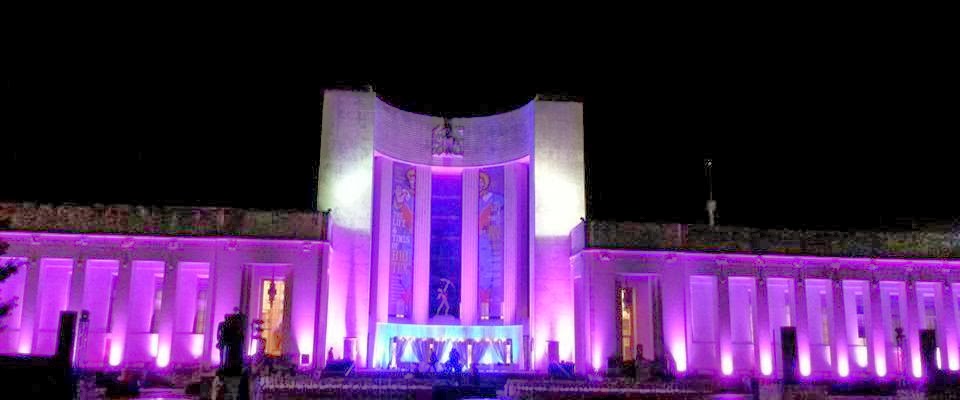
Hall of State at
Fair Park, Dallas, Texas.
Friday, October 25, 2013/ 9:00 PM - 1:00 PM Dismiss


Hon. Kapil Sibal, India's law Minister (Secretary, Department of
Justice) was to be the Chief Guest of the event, unfortunately, he was
called back in the last minute to stay in New Delhi to handle the
national affairs. However, the greatness of the man lay in his response
to the need of the day, he realized his absence will embarrass the
organizers and the people of Dallas/ Fort Worth. So, he took the time to
address the organiser Noor Amrohvi and the audience in a powerful video
message with regrets. We the people of Texas appreciate it and honor
this gesture of dignity.
In 1996, when we held a big Cricket event and invited the Ambassadors of Common
Wealth Nations, and the Ambassador of Australia and New Zealand were bat ready
to come and play, but were pulled back due to back home politics. This
happens.
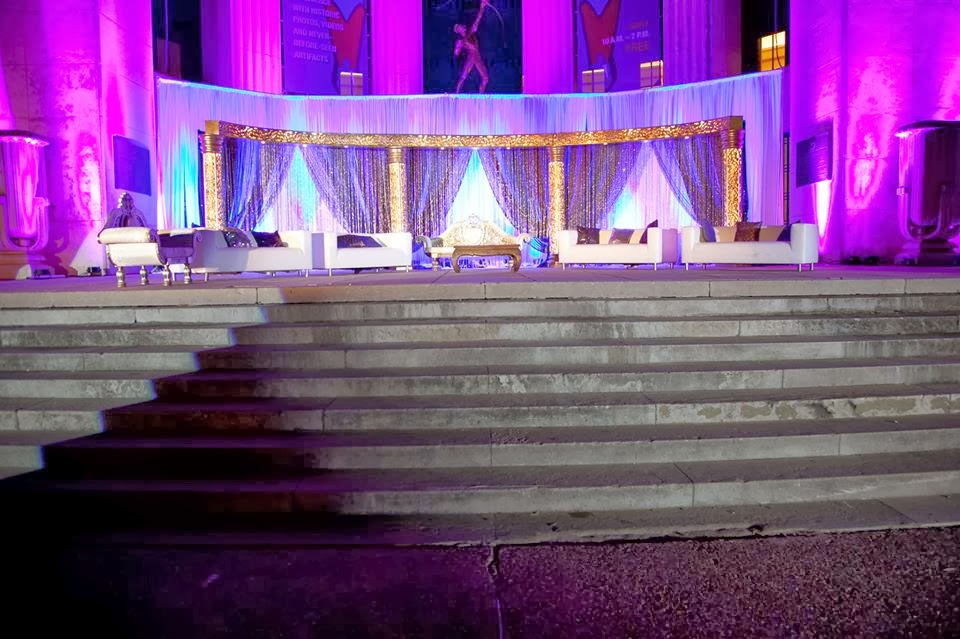
The set up was incredible; I have never seen anything like that. It looked like
Mughal Shahi Darbar or a Roman Coliseum; Corinthian columns in Gold in the back
drop and rows of two white long stretched Sofas that ran across the spectrum of
the outdoor arena. It provided a historicity to the samaa (environment).
Jyoti Kumar was pleased with the efforts of her team made up of Hindus,
Muslims, Sikhs and Christians from the subcontinent. From
the planning stages to the execution of the program, each one in the team was committed
to the unity theme and she is positive about moving forward with the mashaal (torch bearer) of the
Unity.
I would encourage Noor Amrohvi, the Chief Organizer to repeat this set next year. Janab DD Maini
Saheb suggested that we bring the "Kambals" and enjoy the outdoor
program. Tirmizi Saheb said, it happens in UK and Germany. Unfortunately,
weather did not permit sitting outside, and instead, the program was carried in
the auditorium.
Agar Chandni raat hoti to kya baat hoti!
Every poet was great, but as always a few leave lasting impressions on
each one of the audience members. What appeals to you is different than
what appeals to me;
it is as simple as that. The old saying, beauty is in the heart of the
believer
remains an eternal truth. I would encourage you to write your
impressions
in the comment section below, so we have a full range of expressions.
It is not customary to praise a few and skip the others. Indeed, everyone of
the poets came prepared to deliver his and her best and they did, when I get
the time, I will write a note about all the poets, but for the time being, here
are a few mentions.
The biggest hit was Munawwar Rana Saheb, he was everything he was
projected to be; one of the best in Urdu/Hindi poetry. Of course, as
Noor Amrohvi
Saheb said, it’s like "sooraj ko chiragh dikhani wali baat."
His style, voice and delivery kept us all sit with full tawajjay
(attention) through the very end of the program around 1 AM. His poem
Mahajir was just incredible. Indeed, Zia Khan Saheb
was sitting two seats from me, it was his story too... they left
everything
when they went to Peshawar from UP and it is also the story of Maini
Saheb,
whose family sold their stuff in Lahore for damdies and made it to New
Delhi. There was a lot of mention about Allahbad, so I bought his book
and CD to share it with my wife whose mother was from Allahabad. I did
miss
Renu Chandra Saheba, who is also from Allahabad.
I believe it was Sarfaraz Abad Saheb who said, writing poetry is an
amazing experience, you can tell so much in just two lines.... sometimes
the
whole story can be said in a Rubayee - a Qurartet. Poetry is indeed a
powerful story telling medium. That was very encouraging to
me personally, as I am reviving the poet in me after 35 some years of
writing
32 short stories and 43 poems in Urdu/ Hindi, but this time, it will be
on
social issues and religious and societal pluralism.
Dr. Zubair Farooq's poetry won many hearts - he is an Arab, a medical
Doctor
serving two hospitals in Dubai but he has learned Urdu and Hindi, and
has a
passion for the languages, and has written over 24 books. His poetry was
simply
enjoyable and his Urdu accent was delightful and so was his tarannum
(Singing). Of
course we all have different accents of Urdu, ranging from Dakkani to
Punjabi, Bengali, Malayalee, Bihari, Sindhi, Dogri or Gujarati tones.
However the standard bearers of Urdu
are speakers from New Delhi, Karachi and Lucknow.
Why does Dr. Farooq have a passion for the language? Munawwar Rana Saheb
used a sentence for a different purpose, but fits right in... Columbus ka
Khoon! Meaning why did Columbus sail to different lands? Actor Mahmood
would have said, "khujli ka jhaad". Indeed, it was his passion - just
as each one of us is driven by a different passion. Mine is Pluralism, what is
yours? Think about it and make an effort to say in poetry format, you can do it, it is a challenge for you!
Archana Panda Saheba had a powerful message about women and freedom. She shared
a story in her poem, about the laanat (curse) of Dowry. How a girl is
constantly trained to put up with things, the girl in her narrative tells the
Groom off while sitting in the Mandap (wedding altar) to his demands of dowry -
and then comes the most sensitive moment where parents would normally scream at
the girl for bringing shame to the family... instead, her Mother said she
was proud of her for the action, and her father puts his hand around her
giving her confidence that she did the right thing. It is a powerful story and
I hope to pass on her information to Dallas organizations
like Chetna and Muslim Community Center committed to address the domestic violence issues. She will make a good speaker
with little training on Domestic Violence.
When I get the time, I will write a note about the other poets.
I also appreciate the team led by Noor Amrohvi, Jyoti Kumar, Irfan Ali, Azhar
Bukhari, Anand Punjabi, Javed Gill, Sanjeev Gupta, Mushtaq Raes, Nutan Arora, Rehan Kaiser and others. We
should always appreciate the sponsors who believe in the program and make it
happen - Jyoti and Ashok Kumar, SK Mittal and several others were big
supporters.
Noor Amrohvi Saheb
was thorough in appreciating and thanking the poets, volunteers,
sponsors and the supporters - he gets 10 for 10 from me.
Please note that in
March 2014, we will go for the 2nd Annual Pluralism Mushaira/ Kavi Sammelan,
where we are planning to start a new dhar (stream) on poetry with exclusive
focus on social, cultural, religious and work place pluralism. Pluralism in one
sentence is respecting the otherness of others, and when we do that, conflicts
fade and solutions emerge.
# # #
PUBLISHED OUTLINE OF THE PROGRAM
PRESENTED BY AL-NOOR INTERNATIONAL
Kavi Sammelan and Mushaira
AN EVENING FOR PEACE AND UNITY
PROGRAM 9:30 TO 12:30
Chief Guest: Hon. Kapil Sibal, Law Minister, India
Presided by: Hon. Mohammed Adeeb, MP, India
Welcome —Jyoti Kumar
Organizer and MC—Noor Amrohvi
Participating Poets from Dallas
Dr. Qaisar Abbas
Masood Quazi
Saeed Qureshi
Tariq Hashemi
Younus Ijaz
International Poets
Archana Panda
Abhinav Shukla
Khalid Khaja
Sarfaraz Abad
Dr. Kaleem Zia
Dr. Zubair Farooq
Munawwar Rana
Friday, October 25, 2013
Hall of State at Fair Park, Dallas, Texas
Here is an article I wrote for this occasion.
We the people of the Subcontinent
First of all Congratulations to Noor Amrohvi for organizing the peace
Mushaira-Kavi Sammelan in the Hall of State at Fair Park, we need more of these
events to build up a momentum for pluralism and building cohesive societies
where no human has to live in discomfort, apprehension or fear of the other.
As Americans, the Subcontinentian Americans, or Indian, Pakistani, Bangladeshi,
Nepali or Sri Lankan first generation Americans, we are deeply connected to the
land where we were born, and it is a natural for us to be tied to her.
Indeed, the Mitti, the Bhoomi and the Dirt runs in our veins, after all, we
were nurtured and shaped with the water, food and air from that land. It is
that deep connection we have with our motherland that beckons us do our share of
good as a self-balancing act.
I do want to acknowledge the anguish of the people, who have been uprooted from
their homes from Germany, Poland, Vietnam, Palestine, the native peoples and
our own Partition. It must be painful for them who went thru the separation.
The Law of Karma does not spare any one. The whole world suffers when there is
injustice to any, and all of us will pay the price for allowing it to
happen.
One of the first persons to pen such sentiment was Bahaddur Shah Zafar, the
last mogul king who was exiled to Rangoon – and his ghazal ‘Lagta Nahin hai dil
mera, ujde dayaar may” has become an immortal poem of longing for the
motherland.
This also reminds me of Indivar’s song from the movie Upkaar,
Es dharti pay jis nay janam liya, us nay hi paya pyaar tera
Yahan apna paraya koi nahi, hai sub pay ma undhar tera
It is this Udhaar (obligation/debt) that makes most of us Subcontientians to remain connected with the motherland. It is
an unwritten social contract between Maa and the Beta/Beti. Most of us,
the emigrants do our best to fulfill that obligation, while some of us just
don't succeed, being caught up in the web of our life.
Living in the United States, we have a new roop- that of Americans, which means
the old political lines of India and Pakistan become thinner, and sometimes the
divisions look silly. We, the
Subcontinentians, find more in common to come together to celebrate poetry in
the form of Musical Concerts, Kavi Sammelan, Mushairas and Ghazals. It brings all of us together, particularly the
commonality of language and references in the poetry. We feel the same about
love to fellow beings and romance.
Poetry is the best way to express our feelings and I am glad this Mushaira is
taking places here under the open skies of Texas.
I have a dream, and my dream is shaped by my father's dream. It is a larger
dream to include the entire Subcontinent, thanks to America for giving me the
broader perspective. I learned that from
his attitude towards fellow beings. He dreamt an India where every Indian was
respected for who he or she was, as is. He lived that life - the most
significant example was the way he treated the then "untouchables"
during a period when they were not allowed inside your homes. We always had construction
work going, and my mother would serve them tea and food in the same utensils
that we used (funny to say this, but that was a no no then) despite the
criticism from a few. They had given up on him. My father never treated any one
less, nor my mother thought less of any
one. I had a great example to follow.
I am an Indian
American, and take immense pride in the pluralistic ethos of the subcontinent.
Indeed, I have made a commitment to nurture those values, and share them
with fellow humanity in my talks, write ups and media appearances.
As a social scientist, my contribution would be sharing my motherland's
pluralistic heritage with my homeland as a gift to America. By the way,
India was one of the first three nations on the earth to recognize American
independence in 1776; it was Tippu Sultan, the head of the state of Mysore
(Karnataka) along with Morocco and France.
TWO DECADES OF RESEARCH ON PLURALISM
The Asian News Magazine featured the essence of every religion, and the
multi-cultural aspect of India and its inclusiveness, the Asian News Radio
featured weekly hour dedicated to presenting the essence of religious festivals
so we can learn about each other. We also produced more than 500 hours of talk
show radio on religion, every beautiful religion, Pundits, Pastors, Imams,
Rabbis, Shamans and Religious clergy from each faith joined me daily to share
the wisdom of his or her religion, indeed, Atheism and pluralism had its own
slot.
For two years we conducted two sets of workshops called Understanding Religion,
all the beautiful religions (Atheism was part of the learning). We had a Rabbi,
Pastor, Pundit, Imam, Shaman and respective religious ministers joined in
presenting a three hour workshop - on each faith. Funds permitting, I hope to
recommence the workshops, and create a replicable model. The idea was to
demystify the myths about each faith. Two of the most misunderstood faiths are
Hinduism and Islam, and we cannot let people rot in mis-information, we have to
do our share of the work in creating a better world. Of course, finding the
truth is our own individual responsibility.
Each one of us is capable of standing up for others, when we do that; all of us
would be safe. We cannot demand peace, when we are not peaceful within, we
cannot ask others to be hateful, when we are full of it.
We should not dump our issues onto the next generation, we are conquering the
space, we can conquer our prejudices too, that is the greater Jihad (inner
struggle) Lord Krishna and Prophet Muhammad had called for. The nation is
moving forward despite the issues, and we need to take the initiative and bring
closure to them in our life time. They will not go away by burying our heads in
the sand.
INCLUSIVE
ATTITUDES ARE CULTIVATED
Our sense of
responsibility is akin to wearing the seat belt. If you live in America, and
don't wear the seat belt in the car while you drive, not only you feel guilty,
but certainly uncomfortable. It was not the case before the seat belt was made
mandatory for the driver and the front seat passenger. It is indeed a
consciously learned behavior. I feel the same sense of discomfort, when I get
to the podium and not mention or include different religions in the speech. My
only fear is excluding others in the public square even by mistake. To
allay that fear; I have learned to start my speeches with Pluralism greetings
and prayers that are inclusive of every one including my Atheist friends
COMMUNAL RIOTS
My father is my hero and opened the doors of wisdom to us. Pluralism indeed
runs in my family. He taught us one of the biggest lessons of my life in social
cohesiveness and dealing with extremism that I continue to reflect in my talks,
acts and write ups.
During the communal riots in Jabalpur (India) in the early sixties, both
Muslims and Hindus were killed in the mayhem, as it happens every time. I wish
every father in India, America and elsewhere teaches this lesson to his kids.
He was crystal clear on his take; He told us the "individuals" are
responsible for the bloodshed and not the religions. If we get the guy who
started the conflict and punish him for disturbing peace, rather than calling
it a religious issue for the communities to jump in and aggravate it further,
we would have saved many lives. He would emphasize that you cannot blame the
intangible religion and expect justice; we must blame the individuals who
caused it and punish them accordingly for disturbing the peace and thus bring a
resolution to the conflict by serving justice. He said you cannot annihilate,
kill, hang or beat the religion, then why bark at it?
WHAT IS PLURALISM?
Simply put, it is respecting the otherness of the other and accepting the
uniqueness of each one of us. In cultural terms, it is recognizing your culture
as a beautiful expression of life to you, as my own is to me. In religious terms, it is learning to honor
the way your worship or bow to the creator in gratitude, is as divine as my
own.
Pluralism is our future, and as a futurist, based on the trends, I foresee,
that two generations from now, we would be comfortable in saying, my religion,
culture or life style is one of the many choices, and further down the road, a
significant number will proclaim that my way of life is not superior or
inferior to any.
They will consider ‘claiming superiority’ would be sheer arrogance and religion
(a major part of life to many) is believed to imbue humility that builds
societies, communities and nations in creating that elusive kingdom of heaven
where all of us can live without apprehension or fear of the other.
Patriotism should be defined in terms of what you do
to uplift the hopes of people, in terms of education to all, jobs to as many as
we can in each successive year, home for every human, and a better life style
to every Indian.
Each one
of us must do our share in building a cohesive societies, where no one has to
feel alienated, discriminated, apprehensive or fearful of the others.
Every Desi
must be free to eat, drink, wear and believe whatever he or she is comfortable.
WHO
ARE WE?
Our Motherlands whether it is India, Pakistan,
Bangladesh, Nepal or Sri Lanka are represented by every race, nationality,
ethnicity, language, culture and religion. Collectively, we see God as one,
none and many; and in every form; male, female, genderless and non-existent,
being and non-being, nameless and with innumerable names.
Collectively, we are Adivasis, Atheists, Baha’is, Bos, Buddhists, Christians,
Dalits, Hindus, Jains, Jews, Muslim, Scheduled casters, Sikhs, Scheduled
Tribals, Zoroastrians and every possible grouping. We are Brown, Black, White,
Yellow and green with envy, and yet we are one nation and one people and we
need to continue to reinforce that oneness.
Our
combined philosophies believe in one world; Hinduism describes the world as
Vasudhaiva Kutumbukum, the whole world is one family, the idea of Ek Onkar
(one) in Sikhism, you are all created from the same couple as Qur’an puts it
and Jesus embraced every one regardless of who any one is, and similar
philosophies are grounded in all our religions.
Mike Ghouse is a speaker, thinker
and a writer on pluralism, politics, peace, Islam, Israel, India, interfaith, and
cohesion at work place and standing up for others as an
activist. He is committed to building a Cohesive America and
offers pluralistic solutions on issues of the day at www.TheGhousediary.com. Mike
has a presence on national and local TV, Radio and Print Media. He is a
frequent guest on Sean Hannity show on Fox
TV, and a commentator on national radio networks, he contributes weekly to the
Texas Faith Column at Dallas
Morning News, fortnightly at Huffington post, and
several other periodicals across the world. His personal site www.MikeGhouse.net indexes
everything you want to know about him.


 A large number of mushairas and qawwalis are being held in metropolitan cities, thus further helping Urdu make a “comeback”.